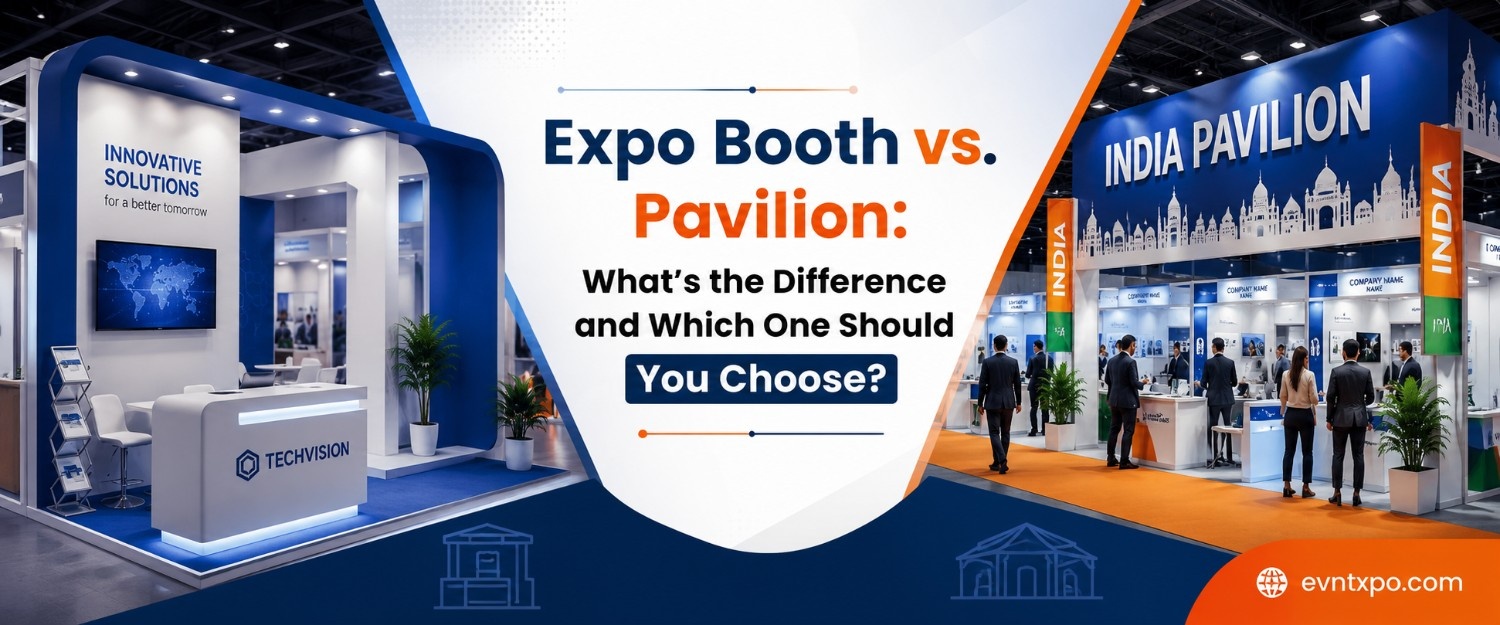
Whether you're a startup attending your first exhibition or an established company looking to expand into new markets, understanding the difference can help you make a smarter investment.
An expo booth is your company's own dedicated space at an exhibition. It's where you showcase your products, meet potential customers, generate business leads, and strengthen your brand.
Think of it as your temporary storefront inside the exhibition hall.
Booths can be as simple as a standard shell scheme with basic walls and furniture or as elaborate as a custom-designed display featuring interactive product demonstrations, meeting areas, and digital screens.
One of the biggest advantages of having your own booth is the freedom it gives you. You decide how your space looks, how visitors experience your brand, and how your team engages with potential customers.
If your goal is to stand out and create a memorable impression, a dedicated booth is often the best choice.
A pavilion is a larger exhibition area that brings together multiple exhibitors under a common theme or organization.
Instead of one company occupying the entire space, several businesses exhibit together. These pavilions are often organized by government agencies, industry associations, export promotion councils, chambers of commerce, or even the exhibition organizer.
You've probably seen examples like the India Pavilion, Startup Pavilion, Innovation Pavilion, or Made in Italy Pavilion at international trade shows.
Each company has its own display area, but everyone benefits from the shared branding and the increased visibility that comes with being part of a larger collective.
For smaller businesses or companies entering a new market, this can be an excellent way to gain exposure without bearing the full cost of a standalone booth.
The simplest way to understand it is this:
A booth represents a single company.
A pavilion represents a group of companies with a shared identity, such as a country, industry, or business sector.
While every exhibitor in a pavilion has its own space, the overall area is designed and promoted as one unified destination for visitors.
There isn't a one-size-fits-all answer. It depends on your business objectives.
If you want complete control over your branding, booth design, and customer experience, a standalone booth is the better option. It's ideal for product launches, live demonstrations, and companies that want maximum visibility for their own brand.
On the other hand, if you're participating in an international exhibition for the first time or working with a limited marketing budget, joining a pavilion can be a smart decision. You'll benefit from shared promotion, collective visitor traffic, and lower setup costs while still having your own dedicated display area.
Budget plays a major role when deciding between a booth and a pavilion.
With a standalone booth, you're usually responsible for everything—from renting the exhibition space to designing the booth, printing graphics, arranging furniture, and managing logistics.
When participating in a pavilion, many of these expenses are shared among exhibitors or handled by the pavilion organizer. This can make participation more affordable, especially for startups and small businesses.
Absolutely. In fact, that's exactly how most pavilions work.
Each participating company has its own booth within the larger pavilion. Visitors can explore different businesses while staying within the same themed area, making it easier for exhibitors to attract relevant buyers.
Before booking your exhibition space, ask yourself a few questions:
Your answers will help determine whether a booth or a pavilion is the better fit.
Both booths and pavilions play an important role in trade shows and exhibitions. A booth gives you independence and full control over your brand presentation, while a pavilion offers the benefits of collaboration, shared promotion, and cost savings.
Neither option is inherently better—they simply serve different business needs.
If you're exhibiting for the first time, joining a pavilion can be a practical way to gain experience and reach new audiences. As your business grows, investing in a standalone booth can give you greater flexibility and a stronger brand presence.
No matter which option you choose, success at an exhibition depends on good planning, engaging visitors, and following up with the connections you make after the event.